
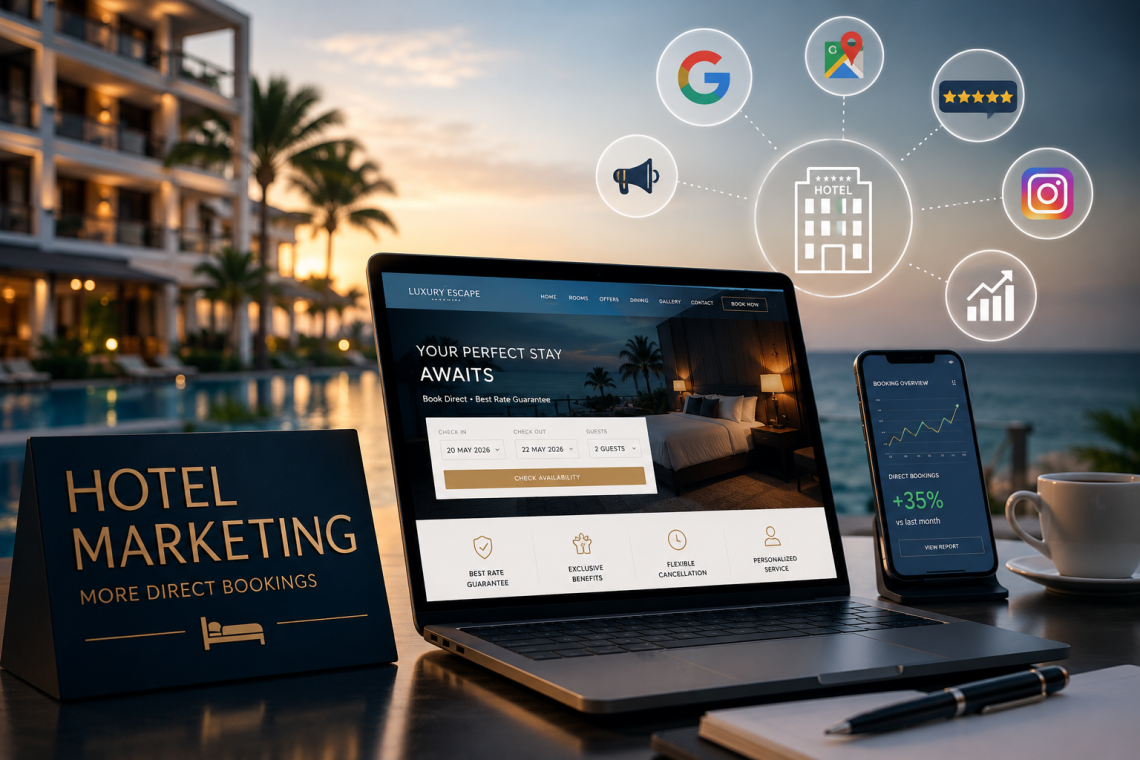
A practical, global guide for hotels, resorts, guest houses, holiday rentals and hospitality entrepreneurs who want stronger visibility, healthier distribution and more profitable direct bookings.
Hotel marketing in 2026 is not simply about gaining followers, running advertisements or appearing on more booking platforms. It is the complete system that helps the right traveller discover your property, trust what they see, compare the offer, complete a reservation and return in the future.
Online travel agencies such as Booking.com, Expedia and Airbnb can be valuable distribution partners. They introduce properties to travellers, support international reach and reduce some of the friction involved in online booking. The danger comes when a hotel has no independent source of demand, no useful customer data, a weak website and no reliable way to turn a first-time guest into a repeat direct customer.
The core strategy: use OTAs for reach, while building assets you control: your brand, website, booking engine, Google presence, guest database, content, reputation and measurement system.
What Is Hotel Marketing?
Hotel marketing is the coordinated process of promoting an accommodation business to suitable travellers and converting attention into profitable stays. It includes research, positioning, pricing, distribution, search visibility, advertising, social media, guest communication, reputation, website conversion and retention.
A complete hotel marketing system covers the whole guest journey:
- Discovery: the traveller finds the property through Google, Maps, an OTA, social media, a travel article, a recommendation or an advertisement.
- Consideration: the traveller studies the location, rooms, photographs, amenities, reviews, policies and total cost.
- Conversion: the traveller books through the hotel website, booking engine, telephone, WhatsApp or an OTA.
- Pre-arrival: the hotel confirms the booking, answers questions and offers relevant extras.
- Stay: the property delivers the experience promised online.
- Post-stay: the hotel requests feedback, manages reviews and encourages repeat business.
The questions travellers need answered
- Is this property suitable for my type of trip?
- Is the location convenient for what I plan to do?
- What exactly does the room include?
- Are the photographs current and truthful?
- What is the final price, including mandatory taxes and fees?
- What are the payment, cancellation and check-in conditions?
- Can I trust the property and the booking process?
- Why should I book directly rather than through an OTA?
Your marketing should answer these questions quickly. Beautiful advertising cannot rescue unclear prices, misleading photography, weak reviews, slow pages or a difficult checkout.
The Direct-Booking Hotel Marketing Framework
| System | Purpose | Typical tools |
|---|---|---|
| Visibility | Help qualified travellers discover the property | SEO, Google Maps, Hotel Center, OTAs, social media, advertising |
| Positioning | Explain who the hotel is for and why it is different | Brand message, photography, offers, destination content |
| Trust | Reduce uncertainty and perceived booking risk | Reviews, accurate policies, secure checkout, transparent pricing |
| Conversion | Turn interest into a confirmed reservation | Website, booking engine, calls, forms, WhatsApp support |
| Retention | Increase repeat stays and referrals | CRM, email, loyalty benefits, post-stay communication |
| Measurement | Identify which channels create profitable completed stays | GA4, booking data, channel reports, call and campaign tracking |
A weakness in one part reduces the value of the others. Excellent Google visibility can produce traffic, but a poor mobile booking experience will lose sales. Strong OTA exposure can fill rooms, but without a retention system the hotel repeatedly pays to reacquire similar guests.
1. Define the Hotel’s Best Guests
Do not try to appeal equally to everyone. Identify the segments that fit the property, location, facilities, price level and operating model.
Possible segments include business travellers, families, couples, airport passengers, wedding guests, conference delegates, remote workers, long-stay guests, domestic weekend travellers, international tourists, diaspora visitors, medical travellers, luxury travellers and budget travellers.
Create a guest-segment profile
- Country or city of origin
- Reason for travel
- Typical booking window
- Expected length of stay
- Preferred room type
- Most important amenities
- Main concerns or objections
- Preferred communication channel
- Likely booking platform
- Seasonal demand pattern
Write a clear positioning statement
Use this formula:
[Hotel name] helps [target guest] enjoy [specific experience or outcome] in [destination] through [distinctive features].
Hypothetical example: “Palm Court Hotel helps families enjoy relaxed coastal holidays in Mombasa through spacious rooms, a children’s pool, airport transfers and direct beach access.”
2. Build a Hotel Website That Converts
A hotel website is not an online brochure. It is a direct-sales channel. Its job is to answer questions, establish trust and move suitable visitors toward checking availability.
Essential pages
- Homepage
- Rooms and suites overview
- Individual room pages
- Offers and packages
- Facilities, dining, spa or experiences
- Meetings, weddings and events where relevant
- Destination or local-area guide
- Gallery
- About the property
- Reviews or guest experiences
- Frequently asked questions
- Contact, directions and map
- Booking, payment and cancellation policies
- Privacy, cookies and accessibility information where applicable
What every room page should show
- Accurate room name and description
- Current photographs
- Maximum occupancy
- Bed arrangement
- Room size where verified
- Bathroom type
- View and floor information where useful
- Amenities
- Accessibility information
- Policies and booking button
Make the booking path obvious
Place a clear “Check Availability” or “Book Direct” button in the main navigation, near the top of the homepage, on every room page and within the mobile layout. Avoid pop-ups that hide important content or create friction.
Explain the direct-booking advantage
Possible benefits include flexible cancellation, free parking, welcome drinks, room preference priority, later checkout when available, direct staff support, airport transfer or a modest dining credit. Only advertise benefits the hotel can deliver consistently.
Important: do not advertise a “best rate” unless you can monitor the complete price across channels, including mandatory fees, taxes, meal plans and cancellation conditions.
3. Choose a Reliable Hotel Booking Engine
A booking engine allows website visitors to check live availability, compare rooms and rates, and complete a reservation. It should work smoothly on mobile and connect properly to the hotel’s operational systems.
Core requirements
- Real-time availability
- Mobile-friendly checkout
- Secure payment handling
- Clear taxes and mandatory fees
- Rate plans and promotional codes
- Multiple currencies and languages where needed
- Confirmation messages
- Property-management-system integration
- Channel-manager integration
- Analytics and conversion tracking
- Data export and ownership clarity
Questions to ask a provider
- What are the setup, subscription, transaction and payment-processing fees?
- Is there a minimum contract period?
- Which countries and payment methods are supported?
- Who owns the guest data?
- Can the hotel export reservation and customer data?
- Does the engine support Google Hotel Center or an approved connectivity route?
- How are cancellations, refunds and failed payments handled?
- What technical support is available?
Configure cross-domain measurement
If the booking engine runs on another domain, configure GA4 cross-domain measurement so the journey can be analysed as one continuous visit. Google specifically documents cross-domain measurement for situations where a business site and a separate shopping-cart or transaction domain are part of the same journey.
Test real booking starts and completed test reservations. Do not assume the integration works because the analytics tag appears on both sites.
4. Master Hotel SEO
Hotel SEO improves a property’s visibility in unpaid search results. A strong strategy targets several types of search intent rather than repeating “hotel in [city]” across many thin pages.
Branded searches
Examples include the hotel name, hotel reviews, booking, address, phone number and cancellation policy. The property should control as much of this search experience as possible through its official website, verified Google profile and consistent public information.
Destination searches
Examples include “hotels in Lagos,” “family resort in Zanzibar,” “hotel near Bologna airport” or “beach hotel in Mombasa.” These searches can be competitive, but well-built accommodation and destination pages can earn long-term visibility.
Specific high-intent searches
Examples include “hotel with parking in Rimini,” “pet-friendly guest house in Nairobi,” “hotel near a conference centre in Abuja” or “family hotel with pool in Cape Town.” These phrases may have lower search volume but often reveal clearer needs.
Create useful local content
- How to reach the hotel
- Airport and railway transfer guidance
- Nearby attractions and business districts
- Beaches, restaurants, shopping and nightlife
- Conference, medical, wedding or religious venues
- Family activities
- Neighbourhood safety and practical expectations
- Public transport
- Accessibility information
- Seasonal events and suggested itineraries
Google’s guidance for AI features continues to emphasise the normal foundations of search: useful original content, accessible pages, sound technical SEO and high-quality images or video. There is no special shortcut required for AI Overviews or AI Mode.
On-page SEO checklist
- One clear page purpose
- Descriptive title tag and H1
- Useful meta description
- Natural related terminology
- Original property information
- Descriptive image alternative text
- Internal links to rooms, offers and local guides
- Clean, readable URLs
- Correct canonical tags
- Important content visible in HTML
- No copied OTA descriptions
- Regular updates when facts change
5. Optimise Google Business Profile and Google Maps Visibility
Hotel owners should claim and verify their Google Business Profile. Verified hotel profiles can manage core business information and edit hotel services and amenities through the hotel attributes section.
Keep these details accurate
- Official real-world business name
- Address and map pin
- Telephone number
- Official website
- Property category
- Hotel attributes and amenities
- Accessibility information
- Current photographs
- Check-in and checkout details
Google states that hotel prices and booking links shown on a hotel profile come from Hotel Ads and free booking links. They are not handled in the same way as ordinary profile links.
How to strengthen local visibility
- Maintain complete and accurate profile information.
- Use the same name, address and telephone information across major platforms.
- Publish a strong location page on the official website.
- Earn genuine guest reviews.
- Respond professionally to feedback.
- Upload current property photographs.
- Gain legitimate mentions from local tourism, event and business websites.
- Keep amenities consistent across the website and distribution platforms.
No guaranteed ranking: Google Maps positions can change according to query, location, competition and other signals. Never pay a provider who promises a permanent number-one Maps position.
6. Use Google Hotel Center and Free Booking Links
Google Hotel Center is used to manage hotel property information, availability, rates and related data for Hotel Ads and free booking links. Free booking links can appear alongside hotel ads in Google’s hotel booking module, and Google states that clicks on these free links do not carry a charge.
Hotels often connect through a booking engine, channel manager or connectivity partner rather than building a direct feed themselves.
Data that must stay accurate
- Property matching
- Room availability
- Rates
- Currency
- Taxes and mandatory fees
- Landing-page destination
- Cancellation and booking conditions
Price mismatches between Google and the final booking page damage trust and can create feed or account issues. Monitor Hotel Center diagnostics, property matching and landing pages regularly.
7. Use OTAs as Distribution Partners, Not Your Entire Strategy
OTAs can introduce a property to new markets, create trust for unfamiliar travellers and generate demand during weaker periods. The commercial objective is a balanced channel mix, not blind dependence or blanket rejection.
Booking.com optimisation
Booking.com’s current partner guidance focuses on complete property information, photographs, facilities, amenities, room details, availability and guest reviews.
- Correct property and room descriptions
- Accurate bed, occupancy and bathroom details
- Current photographs assigned to the correct room type
- Complete facilities and services
- Up-to-date rates and availability
- Clear policies, fees and check-in instructions
- Prompt guest messages
- Professional review responses
Airbnb optimisation
Airbnb advises hosts to use strong photographs, clear descriptions, accurate amenities, suitable pricing and current availability. It also recommends setting honest expectations about the space.
- Use a clear, readable title.
- Lead with the strongest truthful photograph.
- Show every important room or space.
- Describe stairs, shared areas, noise and access limitations.
- Keep the calendar current to reduce avoidable cancellations.
- Review the total guest price, not only the nightly rate.
- Use guest feedback to improve the listing and stay experience.
Expedia optimisation
Expedia Group’s partner guidance emphasises high-quality photographs, detailed amenities, nearby points of interest, current rates and inventory, and transparent policies and fees.
Tripadvisor optimisation
Claim the property listing, keep details and photographs current, monitor feedback and respond professionally. Do not buy reviews or ask staff, relatives or fake accounts to create misleading feedback.
Protect rate and content integrity
Compare the complete booking offer across the hotel website, Google booking links and every major distributor. Include mandatory fees, taxes, meal plans, payment timing and cancellation terms.
Legal note: OTA contracts, rate-parity rules, consumer law and competition rules differ by country. Obtain qualified local advice before changing pricing or distribution practices.
8. Invest in Accurate Hotel Photography
Hotel photography is part of the sales system because guests cannot inspect the room before booking. The images should reduce uncertainty, not create unrealistic expectations.
- Exterior and entrance
- Reception and common areas
- Every room category
- Bathrooms
- Beds, storage and workspaces
- Views
- Breakfast and dining areas
- Pool, spa, gym or beach access
- Parking and arrival route
- Meeting and wedding facilities
- Accessibility features
- Surrounding destination
Use natural editing. Remove images that show old furniture, discontinued services or spaces that no longer match reality. Booking.com’s current photo guidance encourages multiple views of rooms and specific bathroom coverage; exact requirements may vary by property type and connection method.
9. Improve Mobile Usability and Website Speed
Hotel shoppers frequently move between Google, OTAs, social media and booking engines on mobile devices. Test the complete journey on real phones, not only in a desktop browser.
Test these actions
- Open navigation
- Select dates
- Compare rooms
- Read the total price
- Complete forms
- Pay securely
- Receive confirmation
- Call, open maps or start WhatsApp
Google’s Core Web Vitals focus on loading performance, responsiveness and visual stability. The assessment is based on real-user experience at the 75th percentile.
Practical speed improvements
- Compress and correctly size photographs.
- Use modern image formats where supported.
- Lazy-load below-the-fold media.
- Reduce unnecessary third-party scripts.
- Remove unused extensions and tracking tags.
- Cache static resources.
- Prevent layout shifts.
- Optimise fonts and critical CSS.
- Test the external booking engine separately.
- Monitor real-user performance after each major change.
Cloudflare can improve the delivery of static assets and offers image optimisation products, but configuration must match the hotel’s platform. Never cache account pages, payments, personal guest information or live availability responses unless the booking-system provider explicitly supports it.
11. Turn WhatsApp Into a Booking-Assistance Channel
WhatsApp can reduce friction for travellers who want a quick answer before booking. It can support availability questions, directions, transfers, check-in information, group enquiries, weddings and pre-arrival assistance.
Create a controlled workflow
- Display a clear business identity and response hours.
- Use approved templates or automation only where appropriate.
- Collect the minimum information needed for the enquiry.
- Confirm live availability in the reservation system.
- Send a secure payment or booking-engine link where possible.
- Record every confirmed booking in the PMS or central reservation system.
- Send written payment, cancellation and check-in conditions.
Avoid: double bookings, card details in chat, unrecorded reservations, unclear cancellation terms, lost messages and unsolicited bulk promotions. Follow WhatsApp policies and the privacy and electronic-marketing laws that apply in the guest’s and hotel’s jurisdictions.
12. Build an Email and Hotel CRM Strategy
A hotel CRM can organise guest identity, consent, communication, preferences and booking history. It should support useful service and relevant marketing, not uncontrolled data collection.
Useful segments
- Previous leisure guests
- Business travellers
- Families
- Wedding and event guests
- Long-stay guests
- Guests who booked a particular room type
- Guests who stayed in a specific season
- Guests who gave valid marketing consent
Email opportunities
- Pre-arrival guide
- Airport-transfer or upgrade offer
- Seasonal package
- Local event guide
- Abandoned-booking follow-up where lawful and technically supported
- Post-stay review request
- Repeat-stay or win-back campaign
- Loyalty or referral benefit
Privacy, consent, retention and direct-marketing rules differ across countries. Store only necessary data, document the lawful basis for processing and obtain qualified local guidance where required.
13. Manage Guest Reviews and Reputation
Reviews influence trust and reveal operational problems. Monitor Google, OTAs, Tripadvisor, Facebook and relevant local platforms.
How to respond to a negative review
- Thank the guest for the feedback.
- Acknowledge the concern without arguing.
- Protect personal and booking information.
- Clarify material facts carefully when necessary.
- Explain what is being reviewed or corrected.
- Move detailed resolution to a private channel.
Convert feedback into improvement
Create a monthly report grouping complaints and compliments into categories such as cleanliness, noise, Wi-Fi, breakfast, staff service, maintenance, check-in, billing and room accuracy. Marketing cannot permanently compensate for repeated service failures.
Never buy reviews, create fake accounts, offer prohibited incentives or pressure guests to remove legitimate criticism.
14. Connect Pricing to Revenue Management
Revenue management adjusts rate and availability according to expected demand, booking pace, remaining inventory, length of stay, channel cost and business objectives.
Review these factors
- Day of week and season
- Local events and holidays
- Booking lead time
- Length of stay
- Remaining room inventory
- Cancellation patterns
- Historical booking pace
- Competitor positioning
- Room category
- Distribution and payment cost
A high occupancy rate does not automatically mean strong profit. A discounted room sold through a costly channel may contribute less than a well-priced direct booking with lower acquisition cost and additional purchases.
| Metric | Basic formula | What it helps explain |
|---|---|---|
| Occupancy | Rooms sold ÷ rooms available | How much available inventory was used |
| Average daily rate | Room revenue ÷ rooms sold | Average room revenue for sold rooms |
| Revenue per available room | Room revenue ÷ rooms available | Combined occupancy and rate performance |
| Direct-booking share | Direct bookings ÷ total bookings | Channel mix |
| Website conversion rate | Website bookings ÷ eligible website visits | Website and booking-engine effectiveness |
| Acquisition cost | Relevant marketing and distribution cost ÷ acquired bookings | Cost efficiency |
| Cancellation rate | Cancelled reservations ÷ total reservations | Booking quality and policy impact |
Definitions vary between systems. Document the exact formulas used by your hotel before comparing reports.
15. Use AI and Automation Carefully
AI can support hotel teams, but it must not invent facilities, prices, policies, reviews or destination facts.
Useful applications
- Drafting and adapting social content
- Creating content outlines
- Summarising review themes
- Categorising guest questions
- Producing first-pass translations for human review
- Suggesting email subject lines
- Identifying repeated service issues
- Supporting approved chatbot answers
- Assisting specialised forecasting and revenue tools
Chatbot rules
- Identify the automated assistant clearly
- Use an approved, current knowledge source
- Connect to live inventory before confirming availability
- Escalate complex cases to a person
- Protect personal data
- Never invent a policy or guarantee
- Provide a human contact route
- Test every supported language
Google AI search
Google’s official guidance says the same foundational SEO practices remain relevant to AI Overviews and AI Mode. Create accurate, original, useful pages that are crawlable and supported by strong images or videos. Google does not require a special AI text file for inclusion in these features.
16. Use Structured Data Correctly
Structured data helps search engines understand a page, but it does not guarantee a ranking or special result.
Possible types for a hotel website
Hotelor an appropriateLodgingBusinesssubtype on the property websiteLocalBusinessdetails where appropriateOrganizationPostalAddressBreadcrumbListWebSiteandWebPageImageObjectandVideoObjectVacationRentalonly for eligible vacation-rental implementations
Markup must match the visible page. Do not add invented ratings, unavailable prices, copied third-party reviews or facilities the property does not offer.
Google does not display self-serving review stars for a business merely because the business publishes its own reviews with LocalBusiness or Organization markup. Do not promise review stars based on that implementation.
Voice and conversational search
There is no separate “voice SEO” system. Improve clear answers, local details, FAQ content, mobile usability and natural-language coverage of guest questions. Keep contact, location, availability and policy information accurate.
17. Measure the Complete Booking Journey
Install and test analytics before increasing advertising spend.
Track meaningful actions
- Organic search visits
- Google Business Profile actions
- Booking-button clicks
- Availability searches
- Room views
- Booking starts
- Completed reservations
- Revenue and currency
- Telephone, email and WhatsApp clicks
- Form submissions
- Promotion-code use
- Cancellations
- Repeat bookings
GA4 enhanced measurement can collect certain interactions automatically, but hotel-specific booking events usually require additional implementation. Configure cross-domain measurement when the booking engine uses another domain.
Use consistent campaign tagging
Add disciplined UTM parameters to email, paid social, influencer links, QR codes, partner sites and offline campaigns. Keep a naming sheet so reports do not fragment into inconsistent labels.
The real question: how many profitable, completed stays did each channel produce after advertising cost, distribution fees, payment costs and cancellations?
18. Build Seasonal Hotel Marketing Campaigns
Create a 12-month calendar based on your local destination, not another country’s tourism cycle.
Possible campaign triggers
- School holidays
- Religious festivals
- Sporting events
- Conferences and trade fairs
- Weddings
- Summer and winter travel
- New Year and Valentine’s Day
- Local cultural events
- Diaspora travel periods
- Shoulder-season demand
- Long-stay or remote-work periods
Every campaign needs a target audience, offer, dates, booking window, landing page, inventory allocation, tracking plan, cancellation terms and profitability target. Publish major seasonal content early enough to be indexed and promoted before demand peaks.
19. Common Hotel Marketing Mistakes
- Depending entirely on OTAs
- Using outdated or misleading photographs
- Hiding the final price until checkout
- Making the booking button difficult to find
- Sending mobile visitors to a slow booking engine
- Failing to track completed reservations
- Ignoring negative reviews
- Posting social content without a business objective
- Copying descriptions from OTAs
- Advertising to everyone instead of priority segments
- Discounting without calculating contribution and acquisition cost
- Publishing inconsistent hotel information
- Treating marketing as separate from guest experience
- Automating customer service without human escalation
- Publishing generic mass-produced destination pages
- Neglecting previous guests
- Failing to test the complete journey on a real phone
- Making unsupported ranking or earnings promises
- Collecting guest data without a clear purpose
- Changing campaigns before enough reliable data exists
20. Three Practical Hotel Marketing Scenarios
These are hypothetical examples, not documented case studies.
Independent city hotel
A 35-room city hotel receives most reservations through OTAs. It could improve branded Google visibility, connect its booking engine to an eligible Hotel Center route, create pages for nearby business venues, offer useful direct-booking benefits, configure complete analytics and email previous business guests before recurring events.
Seasonal beach resort
A beach resort with weak shoulder-season occupancy could create separate offers for couples, families and remote workers; publish short videos showing food, beach and local culture; promote three- and five-night packages; and retarget previous guests after conversion tracking is verified.
Holiday-rental owner
An owner who depends heavily on Airbnb could improve photography and listing accuracy, create an independent brand website, publish useful local guides, build a consent-based guest database and use WhatsApp for assistance while respecting platform terms and local law.
21. A 90-Day Hotel Marketing Action Plan
Days 1–30: Repair the foundation
- Audit every public hotel listing
- Correct names, contact details and map information
- Claim or review Google Business Profile
- Test the complete booking journey on mobile
- Review booking-engine costs and integrations
- Install or repair analytics
- Record baseline performance
- Update rooms, policies and photographs
- Read recent guest reviews and identify repeated problems
Days 31–60: Improve visibility and conversion
- Rewrite homepage positioning
- Improve each room page
- Add a truthful direct-booking benefit
- Create two high-intent local pages
- Improve mobile speed
- Configure cross-domain measurement
- Review Google Hotel Center connectivity options
- Improve OTA content and photography
- Create a lawful email-consent process
- Prepare one seasonal campaign
Days 61–90: Launch, measure and optimise
- Launch the seasonal landing page
- Promote it through appropriate channels
- Run a controlled advertising test
- Create a review-request procedure
- Segment previous guests
- Compare direct and OTA acquisition costs
- Review booking-engine abandonment
- Improve weak checkout steps
- Measure completed stays and cancellations
- Prepare the next 90-day plan
Frequently Asked Questions
1. What is hotel marketing?
Hotel marketing is the coordinated process of helping suitable travellers discover, evaluate and book a property, then encouraging repeat stays and referrals.
2. What is the best hotel marketing strategy?
The strongest strategy combines visibility, positioning, trust, conversion, retention and measurement. The exact channel mix depends on the property, destination and target guest.
3. How can a hotel get more direct bookings?
Improve the website, mobile booking journey, Google visibility, direct-booking value, reputation, guest follow-up and conversion tracking.
4. Should a hotel stop using Booking.com?
Not necessarily. OTAs can be valuable distribution partners. The objective is usually a healthier channel mix and less excessive dependence.
5. Does a hotel need its own website?
A hotel website gives the property greater control over its brand, content, analytics, guest relationships and direct-booking process.
6. What should a hotel website include?
It should include rooms, accurate photographs, amenities, location information, policies, availability access, contact details, local guidance and a clear booking path.
7. What is hotel SEO?
Hotel SEO improves unpaid visibility for branded, destination, local and high-intent accommodation searches.
8. How can a hotel rank higher on Google Maps?
Maintain accurate information, strengthen the website, earn genuine reviews, publish current photographs and build legitimate local relevance. No ethical provider can guarantee a specific rank.
9. What is Google Hotel Center?
Google Hotel Center is the platform used to manage hotel property, rate and availability data for Hotel Ads and free booking links.
10. What is a hotel booking engine?
It is software that allows travellers to check live availability, compare rates and complete reservations through the hotel website.
11. How much does a hotel booking system cost?
Costs vary by provider, property size, integrations, country and commercial model. Verify setup, subscription, transaction and payment-processing fees directly.
12. Can hotels accept bookings through WhatsApp?
WhatsApp can support enquiries and reservations, but confirmed bookings should be recorded in the official system with clear payment, privacy and cancellation procedures.
13. Which social platform is best for hotels?
It depends on the audience. Instagram and TikTok are strong for visual discovery, Facebook can support local and mature audiences, and WhatsApp is useful for direct communication.
14. How should a hotel respond to negative reviews?
Respond calmly, acknowledge the concern, protect privacy, avoid arguments and explain corrective action where appropriate.
15. Can AI manage hotel marketing?
AI can assist with content, analysis, translation, automation and support, but human oversight remains essential for accuracy, privacy and complex service decisions.
16. Does schema markup guarantee higher rankings?
No. Structured data can help search engines understand content and may support eligibility for certain features, but it does not guarantee rankings or rich results.
17. Which hotel marketing metrics matter most?
Monitor direct-booking share, conversion rate, revenue, acquisition cost, cancellations, occupancy, average daily rate, channel profitability and repeat-guest rate.
18. How quickly does hotel SEO work?
Results vary by competition, location, website condition and authority. Technical fixes can help quickly, while meaningful organic growth usually requires sustained work.
Grow Your Hotel’s Visibility With Afrimasterweb
List your hotel, resort, guest house or holiday rental on Afrimasterweb and reach more potential guests. You can also request a professional hotel website with advanced SEO, mobile optimisation and direct-booking support.
List Your HotelRequest a Hotel WebsiteOfficial Sources and Verification Notes
This guide was checked against current official guidance available on 1 August 2026. Product availability, pricing, contracts and country-specific rules can change; verify them before implementation.
- Google Search Central: AI features and your website
- Google Search Central: Local Business structured data
- Google Search Central: Review snippet eligibility
- Google Business Profile: Manage hotel details
- Google Hotel Center: Free booking links
- Google Hotel Center: Free booking link best practices
- Google Analytics: Cross-domain measurement
- Google web.dev: Core Web Vitals
- Cloudflare Images documentation
- Booking.com Partner Hub: Property page
- Airbnb Resource Center: Help a listing stand out
- Expedia Group: Improve a hotel property listing
Editorial distinction: platform capabilities and technical statements above are based on cited official sources. Strategic recommendations are professional editorial judgment. The three scenarios are explicitly hypothetical and do not claim measured results.







10. Use Social Media and Video to Create Demand
Social media is strongest when it shows the experience behind the room rate. It should help a traveller imagine arriving, staying and enjoying the destination.
Instagram content
Facebook marketing
Facebook can support local awareness, family travel, weddings, events, retargeting, direct messages and previous-guest engagement. Define the commercial purpose of each campaign before spending.
TikTok marketing
Use native, useful formats rather than formal television-style advertisements. Examples include “what this room includes,” a realistic property tour, three nearby activities, a day behind the scenes or a staff member’s local recommendation.
Video principles
Do not treat followers, likes or views as the final business result. Track qualified website visits, availability searches, enquiries and completed bookings.