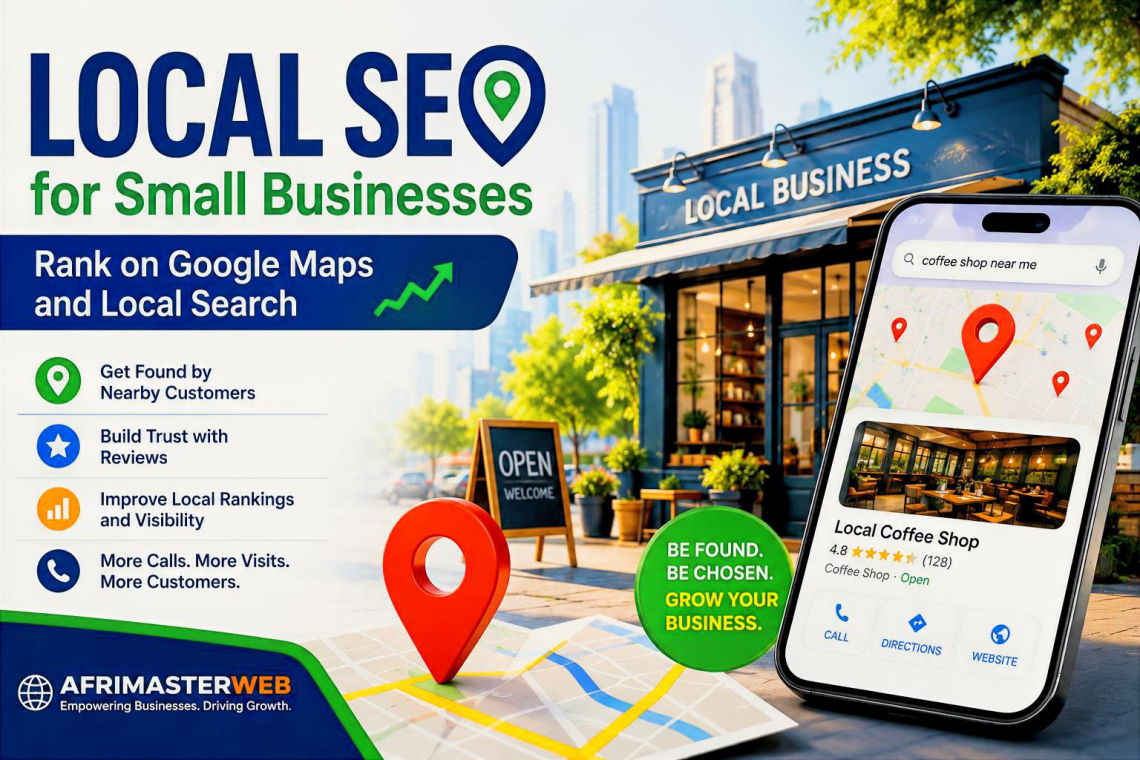
A potential customer needs exactly what your business sells.
They open Google and search:
“plumber near me.”
“best restaurant nearby.”
“accountant in my area.”
“hair salon open now.”
“digital marketing agency near me.”
Your business may be only a few streets away. But if Google doesn't clearly understand what you do, where you operate and why customers should consider you, that search can end with a competitor getting the call.
That is what local SEO for small business is designed to fix.
Local SEO helps a business become more visible when people search for nearby products, services and companies through Google Search, Google Maps and other location-aware search platforms.
For most small businesses, this isn't about attracting millions of visitors.
It's about being visible to the right person, in the right place, at the right moment.
This guide explains how to improve your local visibility through your Google Business Profile, website, reviews, citations, business directories, backlinks, location pages, mobile experience and local content.
If your business specifically targets Nigerian customers, read our dedicated guide on how to rank your business on Google Maps in Nigeria. That article focuses on Nigeria, while this page serves as AFRIMASTERWEB's broader global local SEO pillar.
Last updated: August 2026
Quick Answer: How Do You Improve Local SEO for a Small Business?
To improve local SEO, claim and verify your Google Business Profile, provide complete and accurate business information, choose appropriate business categories, optimize your website for your actual services and locations, earn genuine customer reviews, maintain accurate listings across relevant directories and build trustworthy links and mentions.
Google explains that local search results are mainly influenced by relevance, distance and prominence.
You cannot control every part of that equation.
You cannot move your business closer to every person searching.
But you can make your business easier for Google to understand, easier for customers to trust and more prominent across the web.
What Is Local SEO?
Local search engine optimization, usually shortened to local SEO, is the process of improving a business's online presence so people can discover it when searching for products or services connected to a particular geographic area.
Sometimes the geographic intent is obvious:
dentist in Manchester
mechanic in Lagos
accountant in Toronto
restaurant in Milan
web designer in Abuja
Other searches don't contain a city at all.
Someone might search:
coffee shop near me
petrol station open now
emergency plumber
pharmacy nearby
car wash near me
Google can understand that these searches have local intent.
That is why local SEO involves much more than adding a city name to your website.
It can include:
Google Business Profile
Google Maps
Your business website
Customer reviews
Business directories
Local citations
Local backlinks
Service pages
Location pages
Mobile optimization
Structured data
Accurate contact information
Brand mentions
Local content
The goal is straightforward.
Google and potential customers should be able to understand:
What does your business do?
Where does it operate?
Can it be trusted?
How can someone contact or visit it?
The easier those questions are to answer, the stronger the foundation of your local search presence becomes.
How Google Local Search Works
Business owners often look for complicated Google Maps tricks when Google's own explanation gives us a much better place to start.
Google says local search results are mainly based on three factors:
Relevance
Distance
Prominence
Understanding these three factors helps you decide where to spend your time.
1. Relevance
Relevance describes how closely a business matches what someone searched for.
Imagine someone searches:
“wedding photographer near me.”
Google needs enough information to understand which businesses actually offer wedding photography.
Your business category can help.
Your services can help.
Your website can help.
Your business description and wider online presence can help establish context.
If your profile is vague or incomplete, Google has less information to work with.
This is one reason complete Business Profile information matters.
Don't make search engines guess what your company does.
2. Distance
Distance relates to how far a business is from the person searching or from the location included in the search.
This explains why local search rankings are not fixed.
You may search for your company while standing inside your office and see it in a strong position.
Someone searching the same phrase several kilometres away may see different results.
That doesn't automatically mean something is wrong with your SEO.
Location changes the search environment.
This is also why obsessively checking one Google Maps position can give you a misleading picture of your true visibility.
You cannot control distance in the same way you can improve your website or reviews.
Accept the geographic reality and concentrate your effort on factors you can influence.
3. Prominence
Prominence relates to how established or well-known a business appears.
Google uses information from across the web to understand businesses.
That can include links to a business, information published on websites and customer reviews.
A company with a credible website, genuine reviews, relevant directory listings, local mentions and strong links sends a much different signal from a company that barely exists online outside its Google Business Profile.
This is where local SEO starts connecting with traditional SEO, digital PR, reviews, business listings and reputation management.
Local SEO vs Traditional SEO
Traditional SEO and local SEO share many principles, but they aren't identical.
Traditional SEO often focuses heavily on websites and organic search rankings.
Local SEO adds another layer:
geographic relevance.
It also places much greater importance on Google Business Profile, Maps visibility, customer reviews, citations and real-world business information.
A company can rank organically while struggling on Google Maps.
A company can also have a strong Maps presence but a weak website.
For most location-based businesses, you want both.
Your website provides depth.
Your Google Business Profile improves immediate local discovery.
Your reviews build trust.
Your links and listings reinforce authority.
If you want a deeper explanation of traditional website SEO, read AFRIMASTERWEB's guide to on-page vs off-page SEO.
Why Local SEO Matters for Small Businesses
Small businesses rarely need to reach everybody.
They need to reach enough of the right people.
A bakery in Birmingham doesn't need visitors from every country.
A mechanic in Abuja doesn't need to dominate automotive searches worldwide.
A restaurant in Rome doesn't benefit much from ranking for someone looking for dinner in Manchester.
The value of local SEO comes from combining relevance with proximity and intent.
Someone searching:
“emergency electrician near me”
is probably much closer to making a purchase than someone reading a general article about electrical wiring.
Someone searching:
“best hotel near Rimini station”
may already be comparing places to book.
Someone searching:
“accountant near me”
may be looking for someone to contact today.
Local SEO helps put your business into those decision-making moments.
That is powerful.
Step 1: Claim and Verify Your Google Business Profile
For eligible businesses, your Google Business Profile is one of the most important elements of local search.
Start by claiming and verifying it.
Google recommends verified, complete and accurate business information because it helps Google understand a business and match it with relevant searches.
You can read Google's official guidance on improving local rankings.
Your profile should accurately represent important information such as:
Business name
Primary category
Secondary categories where appropriate
Address
Service area
Phone number
Website
Opening hours
Special hours
Services
Products where supported
Photos
Other relevant attributes
Don't complete these fields once and forget them.
Businesses change.
Opening hours change.
Phone numbers change.
Services change.
Locations change.
Your Google Business Profile should represent the company customers can actually do business with today.
Step 2: Use Your Real Business Name
Your Google Business Profile name should represent your real-world business name.
Don't turn your company name into a list of keywords.
If your legitimate business name is:
Johnson Plumbing
don't rename it:
Johnson Plumbing Best Emergency Plumber London Cheap Boiler Repairs
because you want to rank for those words.
Google provides detailed guidelines for representing businesses on Google.
Build relevance through legitimate optimization instead.
Choose the right category.
Add your real services.
Improve your website.
Create useful service pages.
Earn reviews.
Build local authority.
Those strategies are much more sustainable.
Step 3: Choose the Right Business Category
Categories help Google understand what kind of business you operate.
Your primary category deserves particular attention.
Choose the category that most accurately describes the main thing customers hire or visit your business for.
Ask yourself:
If Google could understand only one classification about my company, what should it be?
That is usually a sensible starting point.
Then add relevant secondary categories if the business genuinely provides additional services represented by those categories.
Don't add categories simply because they contain popular keywords.
More categories do not automatically mean more rankings.
Accuracy matters more.
Step 4: Complete Your Business Information
This sounds basic because it is basic.
It is also frequently neglected.
Look at your Google Business Profile as if you were a customer who had never heard of your company.
Can you immediately tell what the business does?
Can you call it?
Can you visit it?
Can you see when it is open?
Can you reach the website?
Can you understand its services?
Can you recognize the premises?
Could you confidently take the next step?
A profile that leaves customers confused isn't well optimized, regardless of how many SEO tactics have been applied behind the scenes.
Step 5: Keep Your NAP Information Accurate
NAP means:
Name
Address
Phone number
These are core pieces of business information.
Imagine a potential customer finds:
Your website showing one phone number.
A business directory showing another.
Facebook showing an old address.
Another website using your previous company name.
That creates uncertainty.
Search engines also use information from multiple sources to understand businesses, so major contradictions are worth correcting.
This doesn't mean every abbreviation or formatting difference will destroy your rankings.
The real goal is accuracy.
If your company moves, changes telephone number, rebrands or opens additional locations, update your important online listings.
AFRIMASTERWEB has also covered the broader importance of keeping business listings accurate. Relevant directory information helps customers verify that they're dealing with the right company.
Step 6: Build a Website That Supports Local Search
A Google Business Profile is extremely important.
It isn't a replacement for a good website.
Your website gives you much more space to explain:
Your services
Your locations
Your expertise
Your processes
Your pricing approach
Your team
Your business history
Your contact information
Why customers should trust you
A local-business homepage should quickly answer:
What do you do?
Where do you operate?
Compare these two introductions.
Generic:
“We provide innovative, world-class solutions designed around your unique needs.”
Specific:
“Residential and commercial electrical services across Manchester and surrounding areas.”
The second version immediately gives both a customer and a search engine useful context.
Specificity is powerful in local SEO.
Step 7: Create Dedicated Service Pages
One of the most common small-business website problems is putting every service onto one generic page.
Suppose a plumbing company provides:
Emergency plumbing
Boiler repairs
Boiler installation
Bathroom plumbing
Central heating maintenance
Those services solve different problems.
Customers may search for them differently.
If each service represents a meaningful part of the business, a dedicated page can help explain it properly.
A strong service page might cover:
What the service is
Problems it solves
Who needs it
Areas served
What the process involves
Important considerations
Relevant FAQs
Pricing approach where appropriate
Photos
Contact or booking information
Don't create dozens of thin pages simply to target slight keyword variations.
One strong page is better than ten nearly identical pages.
Step 8: Create Location Pages Only When They Add Value
Location pages can be extremely useful.
They can also become a source of low-quality SEO content.
Imagine a company creates thirty pages:
“Plumber in City A”
“Plumber in City B”
“Plumber in City C”
Every page contains essentially the same text.
Only the city name changes.
That doesn't create much value.
A strong location page should contain information that genuinely matters to customers in that place.
For a real branch, that might include:
Address
Phone number
Opening hours
Map
Directions
Parking information
Staff
Available services
Accessibility information
Local photos
Genuine location-specific testimonials
A service-area business might explain what is available in that location and any relevant service conditions.
The page needs a reason to exist beyond capturing a keyword.
Step 9: Make Your Website Mobile Friendly
Local searches frequently happen when people are away from a desktop computer.
Someone looking for a restaurant, mechanic, hotel, pharmacy or emergency service may be using a phone and trying to act immediately.
Your website needs to make that easy.
Check:
Mobile navigation
Loading performance
Clickable phone numbers
Contact buttons
Forms
Font sizes
Image sizes
Page layout
Location information
A customer shouldn't need to pinch, zoom and hunt through your website just to find your phone number.
For a deeper technical explanation, read AFRIMASTERWEB's guide to mobile-first indexing and Google rankings.
Step 10: Build a Genuine Customer Review System
Reviews affect more than reputation.
Google specifically says review count and positive ratings can contribute to local ranking.
But their biggest value may be simpler:
customers read them.
Imagine two competing businesses.
One has a steady stream of recent, detailed reviews.
The other has three old reviews.
Even if both appear in Google Maps, they don't create the same level of confidence.
The goal should not be to collect reviews once.
Build an ongoing system.
A simple workflow can look like this:
Deliver a good customer experience.
Ask for honest feedback at an appropriate moment.
Provide an easy review link or QR code.
Monitor incoming reviews.
Respond.
Learn from recurring complaints.
Do not buy fake reviews.
Do not manufacture customer experiences.
Google's policies prohibit deceptive and manipulated reviews, including prohibited forms of incentivized feedback. You can review Google's Business Profile content policies.
A believable reputation is more valuable than a suspiciously perfect one.
Step 11: Respond to Reviews
When someone leaves a review, don't treat the process as finished.
Respond where appropriate.
A good response to positive feedback shows that customers are noticed.
A professional response to criticism tells future customers something about how your company behaves when things go wrong.
Avoid public arguments.
Don't expose private customer information.
Don't paste exactly the same robotic answer underneath every review.
Remember:
You aren't only writing to the reviewer.
Future customers may read that conversation before choosing your business.
Step 12: Add Useful, High-Quality Photos
Local search can be highly visual.
Customers often want to see what they're about to visit, book, buy or experience.
Depending on your type of business, useful photos can include:
Storefront
Interior
Staff
Products
Food
Hotel rooms
Facilities
Vehicles
Completed work
Before-and-after projects where appropriate
Events
Service equipment
Use genuine, current images whenever possible.
Photos reduce uncertainty.
A potential customer may feel much more comfortable visiting a business when they recognize the entrance and understand what to expect.
Step 13: Build Relevant Business Citations
A local citation is an online reference to a business.
It may contain information such as:
Business name
Address
Phone number
Website
Business category
Description
Citations can appear on:
Business directories
Industry directories
Local business associations
Chambers of commerce
Professional bodies
Tourism websites
Community portals
Supplier websites
Trade organizations
The goal is not to submit your company to every directory on the internet.
Quality and relevance matter.
A legitimate industry directory can be useful.
A respected local association can be useful.
A credible business discovery platform can be useful.
Hundreds of low-quality automated directory listings may create very little real business value.
Use the AFRIMASTERWEB Business Directory as Part of Your Visibility Strategy
This is where AFRIMASTERWEB's educational content connects naturally with business discovery.
The AFRIMASTERWEB Business Directory provides another place for businesses to build a discoverable online presence.
A directory listing should not be treated as a meaningless SEO checkbox.
Treat it like another customer-facing business page.
Where available, complete relevant information such as:
Business name
Category
Contact details
Website
Description
Services
Location
Images
Opening information
Keep the information accurate.
A useful directory listing can help customers discover, understand and verify a company.
That is far more valuable than a low-quality citation created only to generate a backlink.
Step 14: Earn Local Backlinks
Links remain part of the wider SEO and prominence picture.
The strongest local links often come from real relationships.
Potential opportunities include:
Chambers of commerce
Trade associations
Suppliers
Manufacturers
Distributors
Local charities
Community organizations
Events
Sponsorships
Universities
Professional organizations
Local publications
Business partners
Instead of asking:
“Where can I buy hundreds of backlinks?”
ask:
“Which credible organizations already have a legitimate reason to mention this business?”
That question usually produces better opportunities.
AFRIMASTERWEB has also published guidance about on-page and off-page SEO, which explains how external authority connects with the work happening on your own website.
Step 15: Publish Content Local Customers Actually Need
Not every local business needs to become a media company.
Content should exist because customers need it.
A hotel could create:
Local attraction guides
Transport guides
Event information
Neighbourhood guides
Parking information
A property company might publish:
Area guides
Buying procedures
Local price explanations
Moving checklists
A mechanic could explain:
Common warning lights
Maintenance schedules
Common repair problems
Seasonal car care
A restaurant might provide information about:
Menus
Dietary requirements
Group bookings
Parking
Events
Reservations
Good local content answers questions that appear before a customer makes a decision.
That's the standard.
Don't publish filler just because someone told you “Google loves fresh content.”
Publish something worth finding.
Step 16: Use Local Keywords Naturally
Your website should communicate geographic relevance.
That may include location information in:
Page titles
Main headings
Introductory content
Service pages
Contact pages
Location pages
Internal links
Business details
Relevant image alt text
But don't turn your copy into keyword soup.
This:
“Best plumber London, London plumber service, affordable London plumbing company and plumber near me London.”
is not stronger because it contains more keywords.
Write naturally.
Explain your business clearly.
Use locations where those locations genuinely matter.
Search optimization should improve the page, not make it unpleasant to read.
Step 17: Improve Your Internal Linking
Internal links help customers discover useful related information.
They also help search engines understand relationships between pages.
For example:
A small-business marketing guide can link to local SEO.
This local SEO guide can link to a Nigeria-specific Google Maps guide.
A Google Maps guide can link to relevant business listings.
Technical sections can link to deeper mobile SEO or on-page SEO resources.
This creates a topic cluster rather than isolated articles.
For AFRIMASTERWEB, the structure should look like this:
Small Business Marketing
↓
Local SEO for Small Businesses
↓
Google Maps SEO for Nigeria
↓
AFRIMASTERWEB Business Directory
↓
SEO and Digital Marketing Services
This is much stronger than publishing many pages that compete for almost the same keyword.
Step 18: Use LocalBusiness Structured Data Where Appropriate
Structured data is machine-readable information added to webpages to help search engines understand what the page represents.
Google supports LocalBusiness structured data for appropriate business pages.
You can review Google's official LocalBusiness structured data documentation.
Depending on the business and implementation, structured data can describe information such as:
Business name
Address
Telephone
URL
Opening hours
Business type
Structured data is not a magic ranking trick.
It does not automatically move a company to number one on Google Maps.
Its purpose is clarity.
Use it accurately.
Validate your implementation.
Don't mark up information that isn't genuinely represented on the webpage.
Important for AFRIMASTERWEB
This article should use Article or BlogPosting schema, not LocalBusiness schema.
The fact that an article discusses local businesses does not make the article itself a local business.
Actual directory/business pages can use appropriate business structured data when the visible page information supports it.
Step 19: Configure Service-Area Businesses Correctly
Some businesses serve customers without receiving them at a public storefront.
Examples include:
Plumbers
Electricians
Cleaners
Mobile mechanics
Delivery businesses
Home-service professionals
These businesses need to configure their Google Business Profile according to Google's service-area rules.
Don't publicly display a private residential address simply because you think it will improve your rankings.
Represent the business accurately.
Google's Business Profile guidelines explain how eligible service-area and location-based businesses should represent themselves.
Step 20: Build a Proper Multi-Location SEO Structure
A business with fifteen genuine branches requires a different strategy from a one-location company.
Each real location should be easy for customers and search engines to understand.
A strong branch page might include:
Address
Phone number
Opening hours
Maps
Directions
Services
Staff
Accessibility information
Location-specific photos
Relevant FAQs
Avoid automatically creating hundreds of location pages where the only difference is the city name.
Scale useful information.
Don't scale duplication.
Local SEO Is Becoming Bigger Than Google Maps
Google Maps remains extremely important.
But local customer discovery increasingly happens across multiple channels.
A customer could:
Search on Google.
See several local businesses.
Read their reviews.
Visit their websites.
Check social media.
View another directory.
Ask an AI assistant for alternatives.
Finally call or book.
This changes the strategic question.
Don't ask only:
“How can I rank number one on Google Maps?”
Ask:
“When customers investigate my company across the web, does everything they find increase their confidence?”
That is a stronger business strategy.
Search is changing.
AI-assisted search is growing.
People compare companies across more platforms.
A coherent digital identity is becoming increasingly valuable.
How to Measure Local SEO Success
Rankings matter.
They aren't the final objective.
A ranking doesn't pay your bills.
Customers do.
Track performance across several levels.
Visibility
Look at whether the business is being discovered.
Examples:
Search impressions
Business Profile visibility
Local query visibility
Engagement
Look at what people do after finding you.
Examples:
Website visits
Calls
Direction requests
Messages
Booking actions
Leads
Measure:
Contact forms
Phone enquiries
Quote requests
Appointments
Reservations
Revenue
Where possible, connect your marketing activity to:
Sales
New customers
Customer value
Revenue
This creates a much more useful funnel:
Visibility → Engagement → Enquiry → Customer → Revenue
Suppose your visibility doubles but your enquiries remain unchanged.
That's a signal.
Maybe you're attracting the wrong searches.
Maybe your reviews are weak.
Maybe your website isn't convincing.
Maybe competitors have stronger offers.
SEO measurement should help you make decisions.
Common Local SEO Mistakes to Avoid
Keyword Stuffing the Business Name
Use your real business name.
Don't turn your Business Profile name into an advertisement.
Choosing Irrelevant Categories
Use categories that describe what the business genuinely does.
Leaving Business Information Incomplete
A missing phone number, incorrect opening time or obsolete website can cost real customers.
Ignoring Reviews
Reviews affect both reputation and local search performance.
Buying Fake Reviews
Fake reviews create unnecessary policy and reputation risk.
Creating Thin Location Pages
Don't publish dozens of nearly identical pages simply by replacing one city name with another.
Using Outdated Contact Information
Audit important listings after moving, rebranding or changing phone numbers.
Building Thousands of Worthless Citations
Choose directories and platforms that have genuine business relevance.
Ignoring Mobile Users
A difficult mobile website can waste visibility you've worked hard to earn.
Focusing Only on Google Maps
Your website, reviews, directories, links and wider digital presence all matter.
Measuring Only Rankings
Track business results.
Treating Local SEO as a One-Time Project
Businesses change.
Competitors change.
Customers leave new reviews.
Search systems evolve.
Maintenance matters.
A Practical 30-Day Local SEO Plan
Week 1: Fix Your Business Information
Audit your Google Business Profile.
Confirm:
Business name
Primary category
Address
Service area
Phone number
Website
Opening hours
Services
Photos
Then search for your business online and identify major listings containing outdated information.
Correct them.
Week 2: Strengthen Your Website
Review your homepage.
Improve important service pages.
Check your contact information.
Create missing high-value service pages where necessary.
Review location pages.
Improve internal links.
Test the website on mobile.
Check that calls to action are easy to find.
Week 3: Build Trust
Create a simple process for requesting genuine customer reviews.
Respond to existing reviews.
Audit major citations.
Add your company to legitimate business and industry directories.
Where appropriate, create or improve your listing in the AFRIMASTERWEB Business Directory.
Week 4: Build Authority and Measure
Identify legitimate local backlink opportunities.
Publish one useful piece of local content.
Review your Google Search Console data.
Review your Business Profile performance.
Record:
Calls
Leads
Contact forms
Bookings
Direction requests
Revenue where measurable
Then use what you learn to decide what deserves attention next month.
Local SEO Checklist for Small Businesses
Google Business Profile claimed
Business verified
Business name accurate
Primary category accurate
Secondary categories relevant
Address correct
Service area correct
Phone number current
Website URL correct
Opening hours current
Special hours maintained
Services completed
Products added where relevant
Current business photos added
Website optimized for major services
Useful location pages created where appropriate
Website works properly on mobile
Review-request process established
Customer reviews monitored
Reviews answered professionally
Important citations checked
Relevant directory listings created
Local backlink opportunities identified
Structured data evaluated
Search Console monitored
Business Profile performance monitored
Calls and enquiries measured
Sales or revenue tracked where possible
Frequently Asked Questions About Local SEO
What is local SEO for small business?
Local SEO for small business is the process of improving a company's visibility when customers search for products or services connected to a particular location. It commonly includes Google Business Profile optimization, website SEO, reviews, local citations, directories, backlinks and accurate business information.
How do I rank higher on Google Maps?
Start with an eligible and verified Google Business Profile. Provide complete and accurate information, choose appropriate categories, maintain current opening hours, earn genuine reviews, improve your website and build relevant prominence across the web. Remember that Google also considers the searcher's distance from your business.
What are Google's main local ranking factors?
Google identifies relevance, distance and prominence as the main considerations behind local search results.
Can I pay Google to rank number one on Google Maps?
No. Google states that businesses cannot request or pay for a better organic local ranking. Advertising through Google Ads is separate from organic Google Maps and local search rankings.
Do Google reviews help local SEO?
Yes. Google says review count and positive ratings can contribute to local ranking. Reviews also influence potential customers who are comparing businesses.
Should I buy Google reviews?
No. Fake, manipulated or improperly incentivized reviews can violate Google's policies and damage customer trust.
Do I need a website for local SEO?
A Google Business Profile can provide significant visibility, but a strong website allows you to explain your services, locations, expertise and business in much more depth. For long-term growth, the website and Business Profile should work together.
What does NAP mean?
NAP means Name, Address and Phone number. These are important identifying details that should remain accurate across major online listings.
What are local citations?
Local citations are online references to your business, often appearing on directories, association websites, local portals and industry platforms.
Is a business directory useful for local SEO?
A legitimate, relevant business directory can help customers discover your company and reinforce its online presence. Focus on credible directories rather than mass-submitting your company to thousands of low-quality websites.
Businesses can also explore the AFRIMASTERWEB Business Directory.
How long does local SEO take?
There is no guaranteed universal timeframe. Results depend on competition, location, website quality, Business Profile quality, reviews, existing authority and the amount of work required.
Should I create a page for every town I serve?
Only when each page can provide genuinely useful location-specific information. Avoid large numbers of duplicate or near-duplicate city pages created solely to target keywords.
Can a service-area business rank on Google Maps?
Eligible service-area businesses can use Google Business Profile. They should configure their profile according to Google's rules and accurately represent how and where the business serves customers.
Does LocalBusiness schema make me rank higher?
Structured data can help search engines understand your business information, but it is not a guaranteed ranking shortcut. Implement it accurately and follow Google's structured-data guidelines.
Is local SEO useful outside the United States?
Yes. Local search is relevant wherever customers use search engines and maps to discover businesses near them. The specific competition, platforms and customer behaviour can vary by country.
How can a Nigerian business rank on Google Maps?
The same basic principles apply, but Nigerian businesses should also consider local market conditions and country-specific visibility opportunities. Read AFRIMASTERWEB's dedicated guide on how to rank your business on Google Maps in Nigeria.
Start With Accuracy, Then Build Authority
Local SEO isn't about tricking Google.
The strongest strategy is much more practical.
Make your business easy to understand.
Keep your information accurate.
Build a useful website.
Earn genuine reviews.
Develop trustworthy business listings.
Create relevant local content.
Build real relationships and links.
Measure whether visibility is turning into customers.
And keep improving.
Google's local ranking framework gives business owners a useful way to remember the fundamentals:
Relevance. Distance. Prominence.
You cannot move your business closer to every customer.
But you can make your business more relevant.
You can build stronger prominence.
You can create more trust.
And you can make sure that when a potential customer finds you, they have enough information and confidence to take the next step.
If your business serves Nigerian customers, continue with How to Rank Your Business on Google Maps in Nigeria.
For additional website optimization, read AFRIMASTERWEB's guide to on-page vs off-page SEO.
And if you're building your business presence online, explore the AFRIMASTERWEB Business Directory to connect your business with another discovery channel.