- Marketing a small business used to be fairly straightforward.
Put up a sign. Print flyers. Ask satisfied customers to recommend you. Perhaps advertise in a local newspaper or radio station.
Those methods haven't disappeared, but your customer has changed.
Today, someone can discover your business on Google, compare three competitors on Google Maps, read your reviews, check Instagram, ask an AI assistant for recommendations, visit your website and message you on WhatsApp — all before you know that person exists.
That changes what effective small business marketing looks like.
You don't need to be everywhere. You certainly don't need the marketing budget of a multinational company.
You need to be discoverable in the places your customers actually look, credible when they investigate you, easy to contact when they're interested, and good enough at follow-up to turn that interest into revenue.
This guide shows you how to build that system.
Quick Answer: What Is the Best Way to Market a Small Business in 2026?
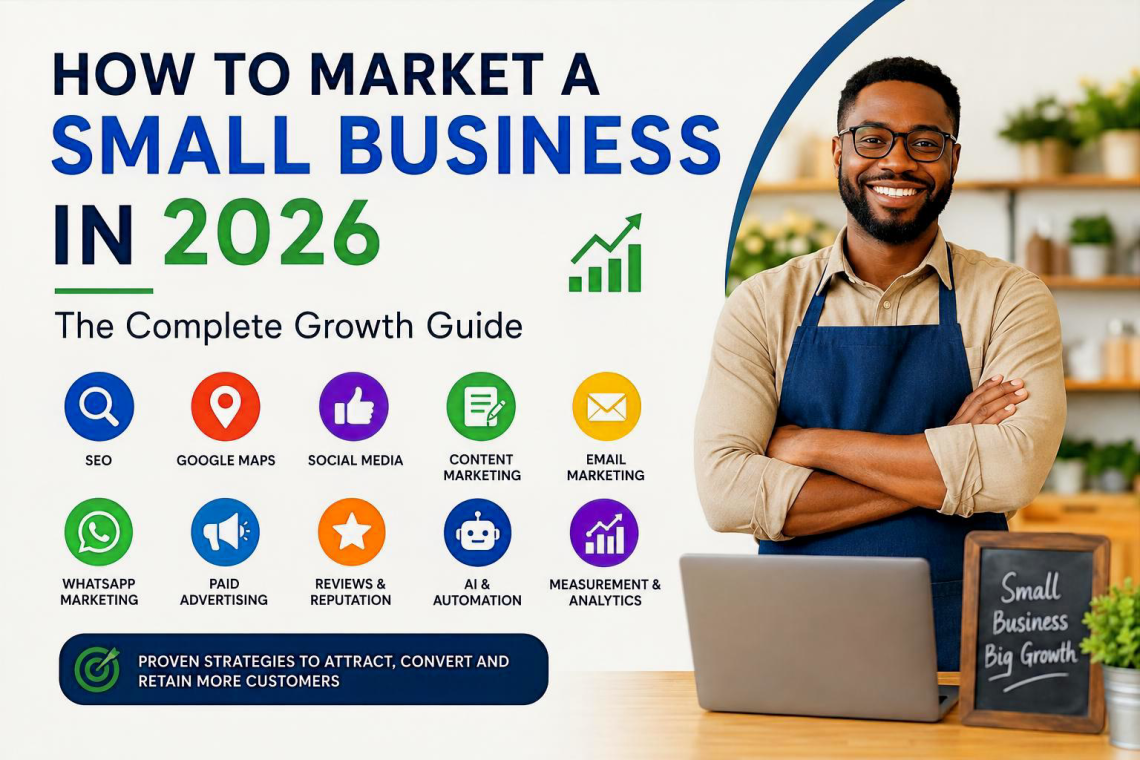
The best small business marketing strategy in 2026 combines a strong website, SEO, Google Business Profile, useful content, social media, customer reviews, email or WhatsApp follow-up, selective paid advertising and consistent measurement.
Don't try every marketing channel simultaneously. Identify where your customers discover businesses like yours, build a strong presence there, measure enquiries and sales, and invest more in the channels producing profitable customers.
What Small Business Marketing Actually Means
Small business marketing is the process of attracting the right people, turning their attention into interest, converting that interest into customers and encouraging those customers to return or recommend the business.
That last part is often forgotten.
Marketing isn't finished when somebody clicks an Instagram post.
It isn't finished when Google sends a visitor to your website.
And it isn't necessarily finished after the first sale.
A good marketing system connects the entire customer journey:
Discovery → Trust → Enquiry → Purchase → Experience → Repeat Purchase → Recommendation
Think about a local restaurant.
A potential customer searches "best Nigerian restaurant near me." They find the restaurant on Google Maps, check its rating, browse photos, open the website, view the menu and finally tap the WhatsApp button to reserve a table.
Was that SEO?
Google Maps marketing?
Reputation management?
Website marketing?
WhatsApp marketing?
It was all of them.
That's why businesses that treat every marketing channel as an isolated activity often struggle.
The channels should work together.
Start With the Customer, Not the Marketing Channel
One of the easiest ways to waste money is to begin with:
"We need TikTok."
Why?
Because everyone is talking about TikTok?
That's not a marketing strategy.
Start with the customer.
Answer five questions:
Who is most likely to buy from us?
What problem are they trying to solve?
Where do they look for a solution?
What makes them choose one business instead of another?
What prevents them from buying?
Consider two small businesses.
A wedding photographer may benefit enormously from Instagram because potential customers want to see previous work.
An emergency plumber may get far more value from Google Search and Maps because customers usually need somebody now.
Same internet. Completely different buying behaviour.
Action Step
Write down your three most valuable customer types.
For each one, record:
Their problem
What they search for
Where they spend time online
Their biggest buying concern
What would make them trust you
Their preferred way to contact you
That one-page exercise can prevent months of random marketing.
Build the Foundation Before Chasing Traffic
Traffic doesn't rescue a weak business presence.
If 5,000 people visit a confusing website with no clear offer, poor photos and no obvious way to contact the company, buying another 5,000 visitors won't solve the underlying problem.
Before promotion, get the basics right.
Your business should have:
A clear name and brand identity
An understandable offer
Accurate contact details
A professional website or landing page
Clear products or services
Realistic pricing information where appropriate
Strong calls to action
Mobile-friendly pages
Customer reviews or other trust signals
Fast ways to contact you
The question every visitor is silently asking is simple:
"Why should I choose you?"
Your marketing needs an answer.
"Quality service at affordable prices" isn't one. Almost every competitor can write that.
A useful value proposition is specific.
For example:
"Same-day laptop repairs for businesses in central Milan, with pickup and delivery available."
Now the customer knows what you do, who you serve and why the offer may matter.
1. Make Your Website the Centre of Your Marketing
Social platforms are useful.
But you don't own Facebook, Instagram, TikTok or LinkedIn.
Algorithms change. Accounts get restricted. Organic reach moves up and down. Platforms come and go.
Your website is the digital property you control.
A strong small-business website doesn't need dozens of pages. It needs the right pages.
At minimum, most businesses should consider:
Home
About
Individual service or product pages
Contact
Location information
FAQs
Testimonials or reviews
Useful educational content
Privacy and legal information appropriate to the business and jurisdiction
A local company serving multiple genuine locations may also benefit from well-developed location pages.
But don't create 100 near-identical city pages and swap the town name in each one. That's not useful local content.
Your Website Has Three Jobs
It should help people:
Understand you.
Trust you.
Take action.
If visitors can't do those three things quickly, redesign before spending heavily on advertising.
2. Use SEO to Capture Existing Demand
Advertising interrupts people.
SEO often catches them while they're already looking.
That's why search visibility can be so valuable to a small business.
Someone searching:
"accountant for small business in Manchester"
"wedding photographer Lagos"
"emergency plumber near me"
"best hotel in Rimini"
"website designer for restaurant"
is revealing intent.
Your job is to create the best relevant page for that intent.
Small Business SEO Starts With Search Intent
Don't ask only:
"What keywords have high search volume?"
Ask:
"Which searches could realistically become customers?"
A furniture company could attract enormous traffic with an article about "history of chairs."
Interesting?
Perhaps.
Likely to sell many sofas?
Probably not.
A page targeting "custom office furniture in Abuja" may attract far fewer searches but considerably more valuable visitors.
Traffic is not the goal.
Profitable visibility is.
3. Build Pages Around Real Services
A common small-business SEO mistake is trying to rank the homepage for everything.
Suppose a digital agency offers:
Website design
SEO
E-commerce development
Social media management
Google Business Profile optimization
Give major services dedicated pages.
That allows search engines — and customers — to understand each offer properly.
A good service page should answer:
What is the service?
Who needs it?
What problem does it solve?
How does the process work?
What is included?
How much might it cost?
How long might it take?
Why should the customer trust you?
What should they do next?
That's more useful than a 200-word page repeating "professional SEO services" twelve times.
4. Create Content That Helps Before It Sells
Blogging still works.
Bad blogging doesn't.
Publishing generic 500-word articles because somebody said "Google likes fresh content" is not a strategy.
Create content around problems connected to what you sell.
A web designer could publish:
How much does a small business website cost?
WordPress vs Joomla for business websites
Why isn't my website appearing on Google?
What should a restaurant website include?
How long does SEO take?
Notice what's happening.
Each article answers a genuine question while moving the reader closer to a relevant service.
That's content marketing doing its job.
Business Insight
A useful blog should not become a random magazine.
Topical concentration matters.
If you sell business software, publishing celebrity gossip because it gets traffic may increase pageviews while weakening the relationship between your audience, your expertise and your commercial goals.
Build authority around what you want to be known for.
5. Optimize Your Google Business Profile
For businesses serving customers locally, your Google Business Profile can be one of your most valuable marketing assets.
Google explains that local results are mainly influenced by relevance, distance and prominence.
You cannot manipulate distance.
But you can improve the information Google and customers have about your business.
Complete your profile carefully.
Pay attention to:
Correct business name
Appropriate primary category
Relevant secondary categories
Address or service area
Opening hours
Phone number
Website
Business description
Services
Products where applicable
High-quality photographs
Customer reviews
Updated information
Don't stuff keywords into the business name unless they're genuinely part of the real-world name.
Consistency builds trust.
6. Google Maps Is a Customer-Acquisition Channel
Local search deserves more attention than many small businesses give it.
Imagine somebody searching:
"barber near me"
They may never open a conventional website result.
They can see:
Businesses
Distance
Ratings
Opening hours
Photos
Directions
Phone numbers
directly in Google.
If your local business isn't competitive there, you're missing customers who may be ready to buy.
Quick Win
Search for your main service from a customer's perspective.
Don't just search your business name.
Try:
"[service] near me"
"[service] + city"
"best [service] + location"
Then compare your presence with the businesses appearing prominently.
What do they have that you don't?
Better photographs?
More reviews?
More complete profiles?
Better websites?
Stronger local relevance?
That gap gives you your first local SEO task list.
7. Customer Reviews Are Marketing Assets
A five-star claim written by the company itself isn't particularly persuasive.
A pattern of genuine customers describing good experiences is different.
Reviews reduce perceived risk.
They can influence:
Local visibility
Click-through
Trust
Conversion
Reputation
Buying decisions
Ask satisfied customers for reviews.
Make the process easy.
A QR code at checkout, follow-up message or direct review link can remove friction.
But don't buy fake reviews.
Don't pressure employees into pretending to be customers.
And don't panic over every negative review.
A thoughtful response to legitimate criticism can demonstrate professionalism.
A Better Review Response
Avoid copying:
"Thank you for your feedback. We value all our customers."
If somebody had a real problem, respond to the actual problem.
A human is reading.
Act like it.
8. Social Media: Choose Your Battlefield
You don't need seven active social accounts.
A small team trying to post daily on Facebook, Instagram, TikTok, LinkedIn, X, Pinterest and YouTube often ends up doing all seven badly.
Choose platforms according to:
Audience
Product
Content format
Buying behaviour
Available time
Creative ability
Useful for community-oriented businesses, local audiences, groups, advertising, events and broad consumer demographics.
Strong for visual businesses such as fashion, beauty, food, travel, fitness, hospitality, design and lifestyle products.
TikTok
Useful when short-form video, demonstrations, education, entertainment or personality can drive discovery.
Often stronger for B2B companies, consultants, recruiters, professional services and thought leadership.
YouTube
Excellent when customers need demonstrations, tutorials, comparisons or deeper education.
The best platform isn't the trendiest one.
It's the one where your customers pay attention and your business can consistently create something worth consuming.
9. Stop Posting Only Promotional Content
Imagine following a business that posts:
"BUY NOW."
"SALE!"
"BOOK TODAY!"
"NEW PRODUCT!"
every day.
You'd probably stop paying attention.
A healthier content mix includes:
Educational Content
Teach something useful.
Proof
Show results, customer experiences, case studies or before-and-after examples.
Behind the Scenes
Show how the work gets done.
Product or Service Content
Explain the offer properly.
Customer Questions
Turn common questions into content.
Personality
Give people a reason to remember the humans behind the company.
Offers
Yes, sell.
Just don't make selling the only thing you do.
10. Repurpose Instead of Constantly Starting From Zero
One strong article can become:
Facebook posts
LinkedIn posts
Instagram carousels
Short videos
WhatsApp updates
Email newsletters
FAQ answers
YouTube scripts
Sales-team resources
That's not lazy marketing.
It's efficient distribution.
You already did the difficult part: producing the insight.
Now adapt it to the way people consume information on different platforms.
Don't simply paste the same 1,500-word article into every channel.
Change the format.
Keep the idea.
11. Use Email to Build an Audience You Can Reach Again
Many small businesses work extremely hard to attract a website visitor and then let that person disappear forever.
Email helps solve that problem.
Offer a legitimate reason to subscribe.
Depending on the business, that might be:
Useful tips
Discounts
New-product announcements
Industry insights
Booking reminders
A checklist
A guide
Early access
Events
Then send emails people actually want.
A basic small-business sequence might include:
Welcome email
Useful resource
Customer story
Common problem and solution
Relevant offer
Don't make every message a promotion.
Earn attention before repeatedly asking for money.
12. WhatsApp Can Shorten the Distance Between Interest and Sale
For many businesses — particularly across African markets and other mobile-first communities — WhatsApp isn't merely a messaging application.
It's part of the sales process.
Customers may want to:
Ask a question
Request a quote
Check availability
Confirm a price
Make a booking
Ask for directions
Get customer support
Make that easy.
WhatsApp Business can also help businesses organize conversations and present business information more professionally.
But don't abuse access to someone's phone.
Unwanted mass messaging is a fast way to turn a useful channel into an irritation.
Practical WhatsApp Funnel
A customer discovers you on Google or social media.
↓
They visit your website.
↓
They tap "Chat on WhatsApp."
↓
An automated greeting asks what they need.
↓
A human takes over where necessary.
↓
The customer receives the right information.
↓
The conversation leads to booking, payment or a clear next step.
That's a funnel.
It just doesn't look like the complicated diagrams marketers love drawing.
13. Use Paid Advertising After You Know What You're Selling
Paid advertising can accelerate growth.
It can also accelerate waste.
Don't start by asking:
"How much should I spend?"
Start with:
"What result are we buying?"
Possible objectives include:
Leads
Purchases
Phone calls
Bookings
Store visits
Website traffic
Awareness
App installs
Then select the channel.
Google Ads
Particularly useful for capturing existing search demand.
Someone searching for an emergency electrician already has a problem.
Meta Ads
Facebook and Instagram can be effective for discovery, retargeting, lead generation and visually compelling products or services.
Meta's advertising system lets advertisers choose campaign objectives around the business result they're trying to generate.
That distinction matters.
Buying cheap clicks is not impressive if none become customers.
14. Start Small With Advertising and Learn
A business with a limited budget shouldn't launch ten campaigns simultaneously.
Test deliberately.
For example:
Campaign A: one offer
Audience: one clearly defined customer group
Location: one target area
Landing page: one relevant page
Conversion: quote request
Then measure.
Change one major variable at a time when possible.
If you simultaneously change the audience, headline, image, landing page and offer, you may improve performance without knowing why.
Warning
Don't send every paid advertisement to your homepage.
If the advertisement promotes commercial cleaning, send people to the commercial-cleaning page.
Make the journey coherent.
15. Retarget People Who Already Know You
Not everybody buys on the first visit.
That's normal.
Retargeting allows businesses to reconnect with people who have previously interacted with the brand, subject to the relevant platform features, consent requirements and privacy rules in the applicable jurisdiction.
A potential customer might:
Visit a product page
Leave
See a relevant advertisement later
Return
Read reviews
Buy
The second visit wasn't necessarily a failure of the first.
It may simply reflect how real buying decisions happen.
16. Use AI as an Assistant, Not Your Marketing Department
Artificial intelligence is changing small business marketing quickly.
It can help with:
Research
Brainstorming
Content outlines
Email drafts
Ad variations
Customer-service assistance
Data summaries
Social-media ideas
Keyword clustering
Meeting summaries
FAQ generation
Workflow automation
But there is a dangerous temptation:
Generate everything. Publish everything. Think about nothing.
That's a poor strategy.
If every business can press the same button, generic AI content isn't much of a competitive advantage.
Your advantage comes from feeding AI things competitors don't have:
Your expertise
Your customer questions
Your photographs
Your experiences
Your product knowledge
Your data
Your case studies
Your opinions
Let AI accelerate your thinking.
Don't outsource the thinking itself.
17. SEO Still Matters in AI Search
There's plenty of discussion about "SEO dying."
Don't build your strategy around dramatic headlines.
Google's own guidance for its generative AI search experiences says foundational SEO best practices remain relevant.
Pages still need to be:
Accessible
Indexable
Helpful
Relevant
Understandable
Trustworthy
The search experience is changing, but businesses still need machines to understand who they are, what they offer and why their information is useful.
What Changes for Small Businesses?
Think beyond "ten blue links."
Your business may increasingly be discovered through:
AI-generated search responses
Maps
Product results
Images
Videos
Reviews
Business profiles
Traditional organic listings
That makes having a coherent digital presence more important, not less.
18. Build a Brand People Search for by Name
SEO helps people who don't know you.
Branding helps them remember you afterward.
A strong small business brand doesn't require a €50,000 rebrand.
It requires consistency.
Use the same:
Business name
Logo
Tone
Core message
Contact information
Visual identity
Customer promise
across important touchpoints.
Over time, customers should stop searching only for:
"web designer near me"
and start searching:
"[your brand] web design"
That change is powerful.
You are no longer competing exclusively as an anonymous option in a list.
19. Your Marketing and Customer Experience Are Connected
Marketing can make a promise.
Operations have to keep it.
A restaurant can run brilliant Facebook campaigns, rank first on Google and have beautiful photography.
If customers wait two hours for food and staff ignore complaints, marketing simply helps more people discover a bad experience.
That eventually catches up with the business.
The strongest marketing strategy includes:
Good products
Reliable service
Fast communication
Clear expectations
Complaint resolution
Follow-up
Sometimes the marketing problem isn't marketing.
It's the experience after the marketing succeeds.
20. Industry Example: Hotel Marketing
Hotels demonstrate particularly well how modern marketing channels overlap.
A traveller may:
Search Google for accommodation.
See a hotel in Maps or organic results.
Compare photos and reviews.
Visit the hotel's website.
Check rooms and amenities.
Look at social media.
Compare an online travel agency.
Contact the property.
Book.
That journey involves local SEO, website optimization, reputation management, content, social media, conversion optimization and direct-booking strategy.
Afrimasterweb has a dedicated Hotel Marketing Guide explaining how those strategies work specifically for hotels.
Use this industry-specific guide as the supporting cluster article beneath this broader small-business marketing pillar.
21. Measure What Produces Business, Not Vanity
Followers are easy to understand.
Revenue matters more.
A business can have 100,000 followers and struggle to make sales.
Another can have 2,000 followers and a waiting list.
Track metrics connected to the actual objective.
Awareness Metrics
Reach
Impressions
Video views
Brand searches
Engagement Metrics
Comments
Shares
Saves
Clicks
Time on content
Lead Metrics
Calls
Forms
WhatsApp enquiries
Quote requests
Bookings
Sales Metrics
Purchases
Revenue
Average order value
Conversion rate
Repeat purchases
Efficiency Metrics
Cost per lead
Customer acquisition cost
Return on ad spend
Marketing cost as a percentage of revenue
22. The Numbers Every Small Business Should Understand
You don't need to become a data scientist.
Start with a handful of questions.
How Many Leads Did We Generate?
Count genuine enquiries, not just website sessions.
Where Did They Come From?
Google?
Maps?
Facebook?
Instagram?
Referral?
Email?
WhatsApp?
How Many Became Customers?
If 100 people enquire and five buy, you have a very different problem from a business where 40 buy.
What Did It Cost to Acquire Them?
Include advertising and other meaningful acquisition costs.
What Are They Worth?
A customer who buys once for €20 isn't financially equivalent to a customer who spends €100 every month for three years.
This is why marketing decisions should eventually connect to business economics.
23. Build a Simple Marketing Dashboard
You don't need twenty-seven graphs.
Start with:
| Metric | This Month | Last Month | Change | Action |
|---|---|---|---|---|
| Website enquiries | ||||
| Calls | ||||
| WhatsApp leads | ||||
| Organic search leads | ||||
| Paid leads | ||||
| Customers acquired | ||||
| Revenue | ||||
| Marketing spend | ||||
| Cost per customer |
Review it monthly.
Ask:
What worked?
What didn't?
What are we changing next?
Marketing gets much easier when those questions become routine.
24. How Much Should a Small Business Spend on Marketing?
There is no universal percentage that makes sense for every company.
A new consumer brand trying to gain market share has different requirements from a 20-year-old accounting firm with strong referrals.
Your appropriate budget depends on:
Revenue
Margin
Growth targets
Customer lifetime value
Competition
Industry
Location
Sales cycle
Existing brand awareness
Cost of advertising
Available staff
Instead of blindly copying a percentage from the internet, work backward.
Suppose acquiring a customer profitably allows you to spend up to €60.
If your marketing system reliably acquires customers for €30, increasing investment may make sense.
If it costs €150, increasing the budget simply scales the loss.
Know your economics.
25. Small Budget? Prioritize in This Order
If money is tight, don't divide €300 across twelve platforms.
Build sequentially.
Stage 1 — Foundation
Fix:
Offer
Website
Google Business Profile
Tracking
Contact process
Stage 2 — Capture Demand
Work on:
SEO
Local SEO
Reviews
Service pages
Stage 3 — Build an Audience
Add:
Useful content
Social media
Email
WhatsApp
Stage 4 — Accelerate
Test:
Google Ads
Meta Ads
Retargeting
Partnerships
Stage 5 — Optimize
Improve:
Conversion
Automation
Customer retention
Measurement
This sequence isn't universal, but it is far safer than trying everything on Monday.
26. Common Small Business Marketing Mistakes
Trying Every Platform
Being mediocre everywhere isn't a strategy.
Marketing Without Tracking
If you don't know what generated the customer, you can't confidently decide what deserves more investment.
Buying Followers
A large fake audience doesn't buy products.
Ignoring Google Maps
Especially dangerous for local businesses.
Neglecting Reviews
Customers investigate.
Creating Content With No Commercial Connection
Traffic alone doesn't pay invoices.
Sending All Ads to the Homepage
Match the landing page to the offer.
Stopping Too Quickly
SEO, content and brand building require time.
Never Stopping Anything
Patience isn't an excuse to keep funding something that clearly doesn't work.
Letting AI Publish Unchecked Content
Speed without judgment creates noise.
Focusing on Acquisition but Ignoring Retention
The customer you already earned may be cheaper to sell to again than finding another stranger.
27. A 90-Day Small Business Marketing Plan
Here's a practical starting point.
Days 1–30: Fix the Foundation
Define target customers.
Clarify the offer.
Audit the website.
Install appropriate analytics.
Set up or improve Google Business Profile.
Correct contact information.
Improve service pages.
Ask recent satisfied customers for genuine reviews.
Identify the five most commercially useful search topics.
Choose one primary social platform.
Days 31–60: Build Visibility
Publish high-quality search-focused content.
Improve local SEO.
Add internal links.
Publish social content consistently.
Start collecting email subscribers where appropriate.
Improve WhatsApp enquiry handling.
Create a simple lead-tracking system.
Build or improve landing pages.
Days 61–90: Test and Scale
Identify the best-performing organic channel.
Launch one focused paid campaign if appropriate.
Retarget eligible audiences.
Improve weak conversion points.
Repurpose winning content.
Track lead quality.
Compare acquisition costs.
Increase investment only where evidence supports it.
At day 90, don't ask:
"Did we post enough?"
Ask:
"What produced customers?"
That's the question that determines the next 90 days.
Small Business Marketing Checklist
Before calling your marketing system complete, check the fundamentals.
Strategy
Target customer defined
Customer problems understood
Clear value proposition
Marketing objective defined
Budget established
Website
Mobile-friendly
Clear services/products
Strong calls to action
Contact information obvious
Trust signals present
Analytics configured
Search
Keyword opportunities researched
Service pages optimized
Google Business Profile completed where relevant
Local SEO addressed
Search performance monitored
Content
Useful content strategy
Customer questions covered
Internal links added
Content updated when necessary
Social
Priority platforms selected
Content supports business goals
Promotional and educational content balanced
Strong content repurposed
Customer Relationships
Review process established
Email capture considered
WhatsApp or messaging process organized
Customer follow-up system exists
Advertising
Clear objective
Relevant landing page
Conversion tracking
Budget limits
Results reviewed
Measurement
Leads tracked
Sales tracked
Lead sources tracked
Acquisition cost monitored
Monthly marketing review scheduled
Frequently Asked Questions About Small Business Marketing
What is small business marketing?
Small business marketing is the process of attracting potential customers, communicating why a business is valuable, converting prospects into buyers and encouraging existing customers to return or recommend the company. It can include websites, SEO, Google Maps, content, social media, email, WhatsApp, advertising, reviews, partnerships and offline promotion. The best combination depends on how the target customer discovers and chooses businesses.
What is the best marketing strategy for a small business?
There isn't one universal channel. A strong strategy usually starts with a clear offer and professional online presence, then focuses on the channels closest to customer intent. For many local businesses, that means Google Business Profile, Maps, reviews and SEO. Visual consumer brands may lean more heavily on Instagram or TikTok, while B2B firms may benefit from LinkedIn, search and email.
How can I market my small business for free?
Start with assets you can improve without buying media: Google Business Profile, useful website content, SEO, social media, customer referrals, reviews, email lists and business-directory profiles. "Free" marketing still costs time, so concentrate on channels likely to reach buyers rather than spending hours producing content simply to stay active.
How can I market a small business with a low budget?
Prioritize high-intent channels. Improve your offer, website and Google Business Profile first. Build reviews, optimize important service pages and publish useful content around questions customers already ask. Choose one or two social platforms rather than five. Once you understand which channels generate enquiries, use a small advertising budget to test a specific offer and track conversions.
Does SEO work for small businesses?
Yes, particularly when customers actively search for the products or services the business provides. Small businesses don't necessarily need to compete for huge national keywords. Local and long-tail searches can have stronger buying intent. The important part is matching pages to genuine customer searches, providing useful information, building credibility and ensuring search engines can crawl and understand the site.
How long does small business SEO take?
There is no guaranteed timeline. Competition, website history, technical quality, content, links, location and search demand all affect results. Some local improvements can produce visibility relatively quickly, while competitive organic rankings may take months or longer. Treat SEO as an ongoing business asset rather than a campaign with a guaranteed completion date.
Is social media enough to market a business?
Usually not. Social media can be excellent for discovery, community and customer relationships, but relying entirely on one platform creates risk. A more resilient system connects social media with assets such as a website, Google presence, customer database, email list or direct messaging channel. That way, the business isn't completely dependent on one platform's algorithm.
Which social media platform is best for small businesses?
It depends on the audience and offer. Instagram suits many visual businesses. TikTok can generate discovery through short-form video. Facebook remains useful for communities, local audiences and advertising. LinkedIn is often stronger for B2B and professional services. YouTube works well for deeper educational content. Choose based on customer behaviour rather than popularity.
Should a small business use WhatsApp for marketing?
For many businesses, yes — particularly where customers already prefer messaging. WhatsApp can support enquiries, quotations, bookings, customer service and follow-up. Use it respectfully. Customers giving a business their phone number isn't permission for endless promotional messages. Follow applicable privacy, consent and messaging requirements in your jurisdiction.
Is email marketing still useful?
Yes. Email gives businesses a direct way to communicate with people who have chosen to hear from them. It can support customer education, promotions, product launches, retention and follow-up. The quality of the list matters more than simply collecting huge numbers of addresses. Build permission-based lists and send messages useful enough that people want to remain subscribed.
Should a small business pay for advertising?
Paid advertising makes sense when the business has a clear offer, appropriate landing page, conversion tracking and enough margin to acquire customers profitably. Advertising should not be used to hide fundamental problems such as poor service, a confusing website or an unattractive offer. Start with controlled tests and scale when the numbers justify it.
How can AI help small business marketing?
AI can accelerate research, brainstorming, content planning, customer-service workflows, ad variations, data analysis and administrative work. It works best when guided by genuine business knowledge. Avoid publishing large volumes of generic AI content without expert review. Your customer insights, experience, examples, opinions and data are what make AI-assisted marketing distinctive.
How important are customer reviews?
Very important for businesses where customers compare alternatives before purchasing, particularly local businesses. Reviews can reduce perceived risk and provide social proof. Google also states that review quantity and positive ratings can contribute to local prominence. Focus on earning genuine reviews through good customer experiences rather than trying to manipulate ratings.
How do I know if my marketing is working?
Connect activity to business outcomes. Track where enquiries originate, how many become customers, how much revenue they generate and what acquisition costs. Supporting metrics such as impressions, clicks and followers can diagnose performance, but they shouldn't replace leads, customers, revenue and profitability when those are the actual business objectives.
What should I do first after reading this guide?
Define your target customer and choose one measurable growth objective for the next 90 days. Then audit your website, Google presence, reviews and lead-handling process. Fix obvious weaknesses before adding more channels. Once the foundation works, concentrate resources on the one or two acquisition channels most closely aligned with how your customers search and buy.
Final Action Plan
Small business marketing becomes much less confusing when you stop thinking of it as a collection of apps.
Build a system.
First: understand the customer.
Second: create an offer worth noticing.
Third: build a trustworthy website and search presence.
Fourth: earn visibility through SEO, Maps, content and appropriate social platforms.
Fifth: capture relationships through email, WhatsApp or another suitable channel.
Sixth: use advertising to accelerate what already shows promise.
Seventh: measure customers and revenue, then reinvest in what works.
You don't need to outspend the biggest company in your market.
You need to understand your customer better, appear at the right moment, earn their trust and make buying easier.
That's a far more achievable competitive advantage.
AFRIMASTERWEB CTA
Ready to Grow Your Business Online?
Getting more traffic is useful. Getting the right customers is better.
Afrimasterweb helps businesses strengthen their online presence through website development, SEO, digital marketing and business visibility solutions.
Explore more practical business and marketing guides on Afrimasterweb, list your business where appropriate, or contact the team when you need professional support building your digital growth strategy.